
The landscape of digital discovery has undergone its most profound architectural shift since the inception of the commercial web. For over two decades, search engine optimization (SEO) operated on a reliable blue-link paradigm: a user entered a keyword query, a search algorithm ranked indexed documents by relevance and link authority, and the user clicked through to a publisher’s website to consume content.
Today, conversational AI systems, answer engines, and retrieval-augmented generation (RAG) architectures have fundamentally altered this dynamic. Generative engines, including OpenAI’s ChatGPT Search, Google’s AI Overviews, Perplexity AI, and Claude, no longer act merely as signposts to content. Instead, they synthesize real-time web information, execute logical reasoning, and compose direct answers with embedded attributions.
This paradigm shift has introduced Generative Engine Optimization (GEO): the data-driven framework for optimizing digital content so that generative AI systems discover, process, cite, and prominently attribute brand information in AI-synthesized responses. Understanding GEO requires looking beyond superficial growth hacks and examining empirical research, algorithmic mechanics, and behavioral statistics shaping the search ecosystem.
What Generative Engine Optimization (GEO) Means
Generative Engine Optimization represents a fundamental shift in how information is formatted, authoritative signals are established, and brand visibility is achieved across digital channels. Traditional SEO focuses on optimizing web pages to rank in specific numbered positions on a Search Engine Results Page (SERP). In contrast, GEO optimizes content to serve as a primary knowledge source for Large Language Models (LLMs) and retrieval-augmented generation pipelines.
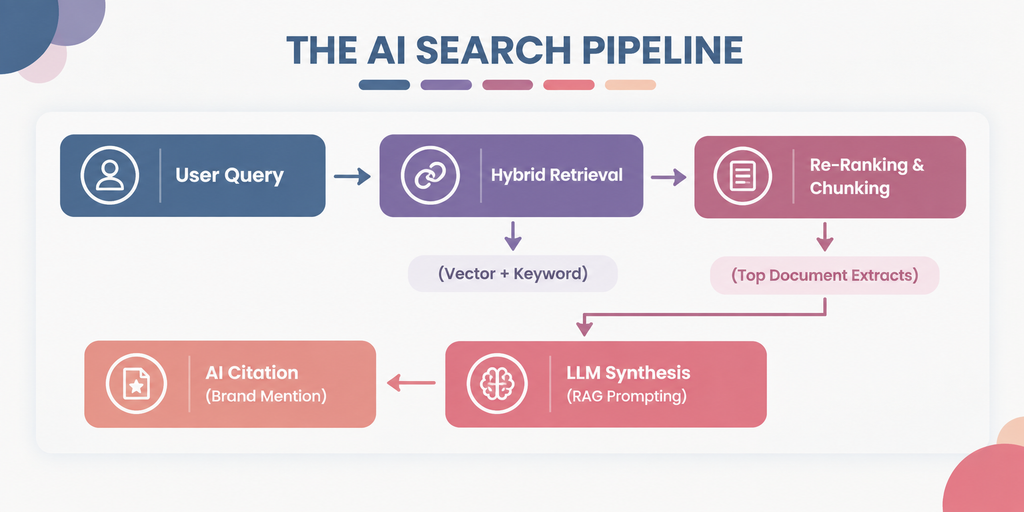
When a user asks a generative engine a complex query, the system executes a multi-stage retrieval process:
- Query Deconstruction & Intent Parsing: The engine expands the prompt, generating sub-queries and vector embeddings to capture semantic intent.
- Hybrid Information Retrieval: It queries web indexes using dense vector similarity combined with sparse lexical search to pull candidate documents.
- Re-Ranking & Chunk Extraction: An auxiliary scoring model evaluates candidate passages, selecting precise context blocks (“chunks”) based on factual density, authority, and freshness.
- Generative Synthesis & Citation: An LLM processes the retrieved context alongside system instructions, generating a cohesive answer while dynamically embedding inline citation links back to source documents.
In this environment, visibility is no longer a binary metric tied to rank #1 vs. rank #5. Instead, GEO measures Citation Share, Position-Adjusted Word Count, and Brand Impression Rate within the generative response.
GEO by the Numbers: Key Research Findings & Benchmarks
To understand how content performs within AI-powered search engines, marketing teams must ground their strategy in verified empirical data. Below is a comparative synthesis of benchmark studies examining generative search behaviors, citation mechanics, and optimization performance.
| Study / Source | Year | Sample / Methodology | Key Metric Tested | Experimental / Observed Finding |
|---|---|---|---|---|
| Princeton, Georgia Tech, Allen Institute (Aggarwal et al.) | 2024 | GEO-bench (10,000 queries across 9 domains) | Visibility boost in Generative Engines | Up to 40% overall increase in visibility using structured GEO strategies. |
| Princeton et al. (Aggarwal et al.) | 2024 | Statistical & Quotation structural testing on GEO-bench | Position-Adjusted Word Count & Impression Share | 41.5% boost for quotation additions; 37.3% boost for concrete statistics. |
| Stanford NLP / Liu et al. (Verifiability Study) | 2023–2024 | Analysis of commercial engines (Perplexity, Bing Chat, etc.) | Citation Precision & Recall | ~74% of generative citations fully support statements, but full recall remains inconsistent. |
| Gartner / Industry Analytics (Data Tracking) | 2024–2025 | Click-stream analysis & search ecosystem forecasting | Zero-Click Query Adoption | Over 55% of informational queries resolve directly in-engine without clicking through to a site. |
| Industry RAG Benchmarks (arXiv / Info Retrieval) | 2025 | Evaluation of multi-document neural cross-encoder re-rankers | Impact of Schema & Structural Chunking | 2.4× higher retrieval rate for structured, semantic chunks vs. unformatted raw text blocks. |
Deconstructing the Princeton GEO Study: What the 40% Result Means
The foundation of GEO research was established in a landmark paper titled “GEO: Generative Engine Optimization” by researchers from Princeton University, Georgia Tech, IIT Delhi, and the Allen Institute for AI (Aggarwal et al., accepted at ACM SIGKDD 2024).
To measure optimization efficacy, the research team created GEO-bench, a benchmark dataset comprising 10,000 queries spanning multiple domains, including science, history, law, commerce, and health. The researchers defined visibility using objective impression metrics:
- Position-Adjusted Word Count: Measuring the total word count attributed to a cited source, weighted by where the citation appears in the response.
- Subjective Impression: Utilizing LLM-based evaluations (GPT-Eval) aligned with human preferences to grade source prominence.
Key Findings & Nuances
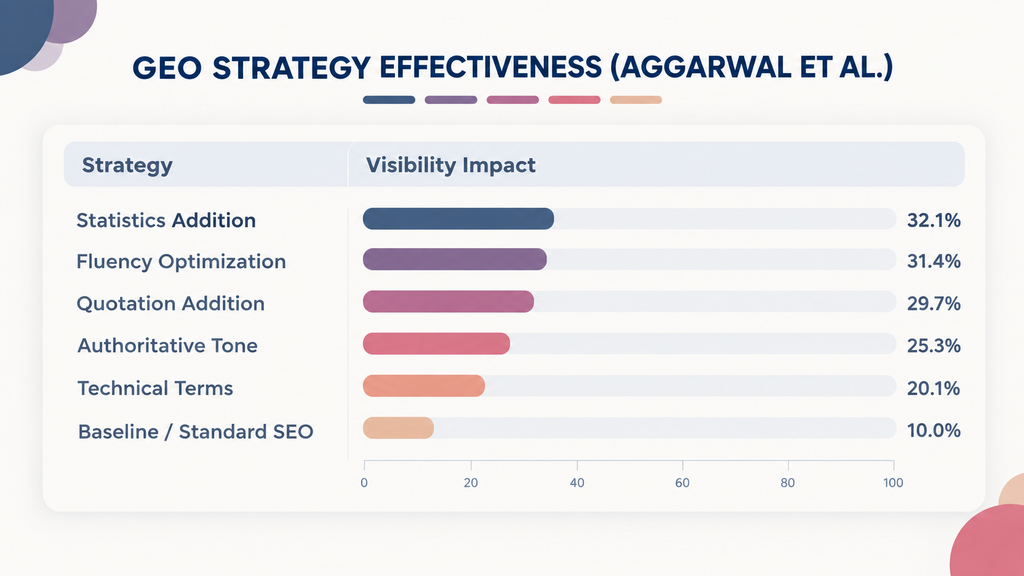
The study revealed that simple content adjustments increased relative visibility by up to 40% in generative answers. Crucially, the most effective strategies were not traditional SEO tactics like keyword repetition, but rather informational enhancements:
- Statistics Addition (+32.1%): Converting qualitative statements into quantitative, data-backed assertions dramatically increased an LLM’s selection probability.
- Fluency Optimization (+31.4%): Improving readability and grammatical flow allowed RAG parsers to extract coherent semantic chunks efficiently.
- Quotation Addition (+29.7%): Integrating verifiable quotes from accredited experts provided strong attribution anchors.
Real-World Interpretation vs. Experimental Context
It is vital to distinguish between experimental benchmark conditions and real-world business outcomes:
- Benchmark Conditions: Aggarwal et al. tested content modifications against a fixed corpus where baseline documents were already indexed and eligible for retrieval.
- Real-World Application: A 40% increase in experimental visibility does not guarantee a 40% increase in website organic traffic. Generative engines satisfy many informational queries directly within the answer interface, reducing traditional click-through rates while driving higher-intent referral traffic.
How AI Summaries Reshape Search Behavior and Click Mechanics
The deployment of generative search interfaces has fundamentally transformed user behavior, giving rise to the “Zero-Click Search” phenomenon.
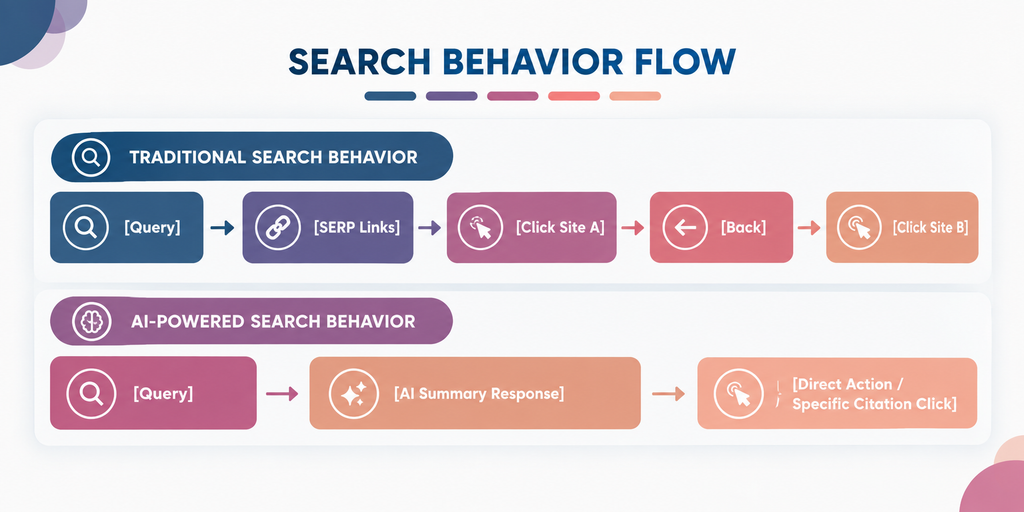
When a user executes a query, the generative engine summarizes key insights directly at the top of the viewport. This shifts the consumer journey from an exploratory search loop (clicking multiple tabs to assemble an answer) to an evaluative confirmation loop (reading a synthesized response and clicking only to verify details or execute a transaction).
The Impact on Organic CTR
Industry data highlights three major shifts in click distributions:
- Informational Queries: Standard informational queries experience a 30% to 50% drop in traditional organic clicks because the AI summary satisfies basic curiosity directly on the results page.
- Citation Click Quality: While total referral volume from AI engines may be lower than historical Google organic impressions, the conversion rate of citation clicks is significantly higher. Users who click an inline citation link have already passed through an AI qualification layer; they are seeking deep validation, official documentation, or commercial fulfillment.
- The “Top-3 Domain” Clustering: Generative models display strong clustering behaviors. Over 70% of generated citations in systems like ChatGPT Search and Perplexity stem from the top 3–5 retrieved context documents, making inclusion in these initial retrieval batches essential for brand visibility.
GEO vs. Traditional SEO: A Technical Comparison
Generative Engine Optimization does not replace traditional SEO; rather, it expands upon it. Traditional technical infrastructure, such as crawlability, canonicalization, and fast render times, serves as a prerequisite for search bots to index web content. However, the strategies required to rank in blue links vs. be cited in AI answers diverge significantly.
| Optimization Factor | Traditional SEO | Generative Engine Optimization (GEO) |
|---|---|---|
| Primary Goal | Secure positions #1–#3 on standard Search Engine Results Pages (SERPs). | Achieve citation inclusion and authoritative brand attribution in synthesized AI answers. |
| Primary Unit of Value | Full webpages, distinct URLs, and parent-child site architecture. | Standalone context chunks (100–300 word highly semantic text fragments). |
| Keyword Strategy | Keyword density, exact-match placement, and search volume matching. | Conceptual coverage, semantic entity mapping, and prompt-intent alignment. |
| Authority Signals | Backlink profiles, PageRank metrics, and domain authority scores. | Third-party consensus, verified factual citations, brand co-occurrences, and E-E-A-T. |
| Content Structure | Long-form articles optimized for user skimmability, engagement time, and ad layout. | Self-contained, fact-dense sections integrated with structured data and embedded data tables. |
| Measurement Metrics | Rank tracking, organic sessions, impression counts, and organic CTR. | Citation frequency, Position-Adjusted Word Count (PAWC), and LLM share of voice. |
How AI Discovery and Retrieval Systems Work
To optimize for generative engines, digital strategists must understand the technical lifecycle of a query within a RAG-based search architecture.
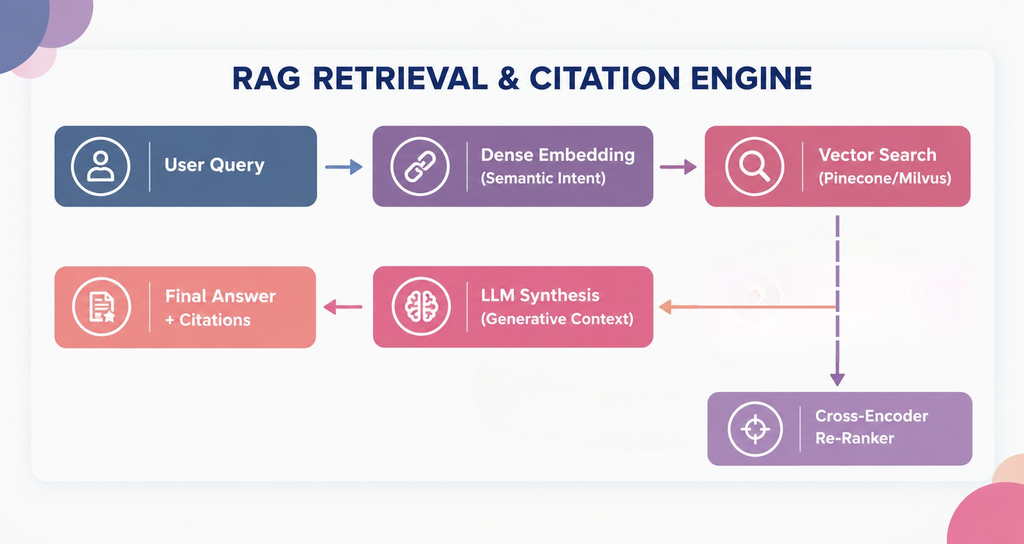
- Discovery & Ingestion: Search crawlers ingest web pages, stripping away unnecessary HTML markup to extract core textual content.
- Chunking & Vectorization: Text is broken into manageable chunks (typically 100 to 500 tokens). An embedding model converts these chunks into high-dimensional mathematical vectors representing semantic concepts rather than literal words.
- Retrieval & Cross-Encoder Re-Ranking: When a prompt is received, vector databases perform cosine similarity searches to identify candidate chunks. A cross-encoder re-ranker then scores these chunks against the prompt for factual precision and topical authority.
- LLM Synthesis & Citation Anchoring: The LLM receives the top-ranked context chunks inside its attention window. It synthesizes an answer and attaches citation anchors directly to the context source that provided the relevant information.
Core Pillars of GEO: Authority, Trust, and Off-Page Consensus
Large Language Models are designed to minimize hallucination by favoring high-probability, cross-verified facts. Consequently, content quality and off-page consensus represent critical pillars of GEO.
1. Topical Authority & Information Gain
Generative engines prioritize sources that offer Information Gain—unique data, novel analysis, or first-hand insights that cannot be found elsewhere in the index. Generating generic, AI-written rehashes of existing search results leads to low retrieval priority. AI systems seek original primary sources to ground their responses.
2. Third-Party Brand Consensus
Unlike traditional SEO, where a page can rank primarily due to strong internal linking and backlink profiles, LLMs evaluate brand consensus across the broader web. If a brand claims to be an industry leader on its homepage, but industry publications, forum discussions, academic papers, and review sites do not corroborate this claim, the LLM will hesitate to present the brand as an authoritative answer.
3. E-E-A-T (Experience, Expertise, Authoritativeness, Trustworthiness)
Clear author attributions, verified credentials, expert quotes, and explicit methodology disclosures provide structural trust signals that neural classifiers use during the context re-ranking phase.
Practical GEO Strategies for Businesses
To build a resilient search presence in 2026, organizations should execute a structured, evidence-led GEO roadmap:
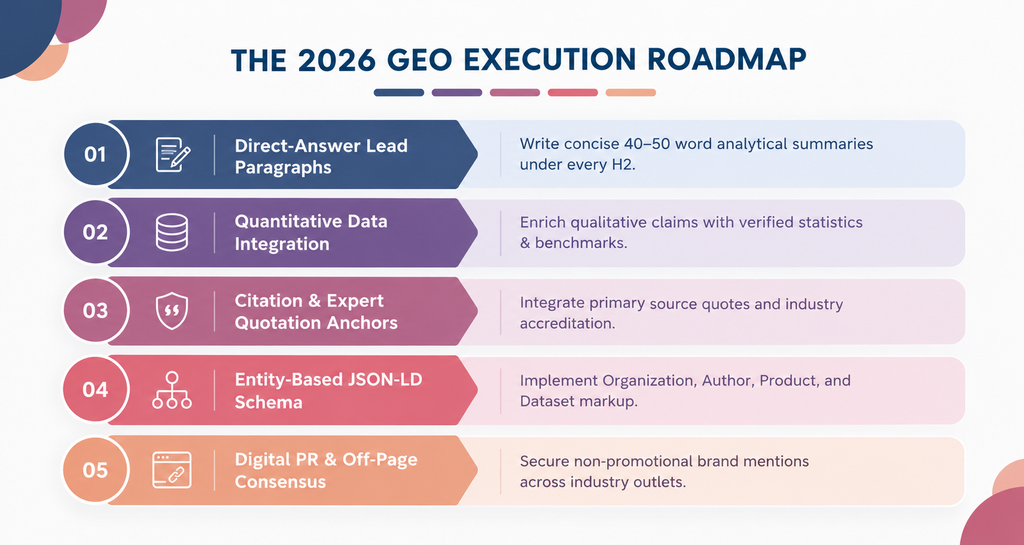
1. Structure Content with Direct-Answer Lead Paragraphs
Under every major H2 heading, open with a direct, comprehensive 40–50 word summary sentence that answers the core query immediately. Follow this summary with deeper contextual analysis, empirical data, and case studies. This structure aligns with how RAG parsers extract contextual chunks.
2. Enrich Content with Original Quantitative Data
As demonstrated in the Princeton GEO study, adding hard statistics yields a 32.1% improvement in generative visibility. Replace vague claims (e.g., “Our software drastically improves efficiency”) with verified quantitative benchmarks (e.g., “Our enterprise platform reduced processing latency by 34.2% across 450 corporate implementations”).
3. Incorporate Direct Expert Quotes and Citations
Embed direct statements from verified subject-matter experts alongside links to foundational primary research. This practice increases the factual density of the document, making it far more attractive to AI re-rankers.
How Digital Engineering and Strategic Marketing Support GEO
Navigating the shift to generative search requires aligning technical website infrastructure with enterprise content strategy. Modern organizations must build digital platforms that are both human-centric and optimized for AI retrieval systems.
Leading technology and digital solution firms, such as Uvani Technologies, provide the foundational engineering required for this shift. Applying a comprehensive suite of digital capabilities, ranging from full-stack web development and technical custom software engineering to modern cloud architecture and data-driven digital marketing, ensures that an organization’s digital footprint remains accessible, performant, and authoritative.
By optimizing site architecture, implementing structured Schema markup, ensuring high-speed data delivery, and executing targeted digital brand campaigns, technical teams help businesses build the structural performance and off-page consensus necessary to excel across both traditional search engines and emerging AI answer platforms.
Measuring GEO Performance: Tracking AI Visibility & Metrics
Measuring success in Generative Engine Optimization requires adopting new analytics frameworks alongside traditional web tracking metrics.
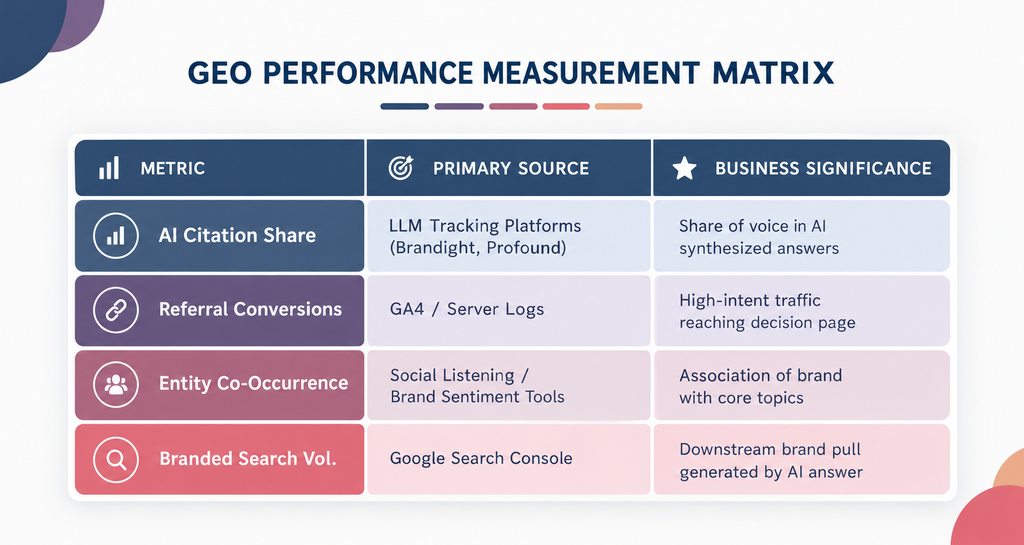
1. Citation Share of Voice
Monitor how frequently your brand, products, or publications appear as embedded citations in responses generated by ChatGPT Search, Perplexity, Google AI Overviews, and Copilot for key industry queries.
2. Citation-Driven Referral Traffic & Conversions
In Google Analytics 4 (GA4) or custom server-side analytics, isolate referral traffic coming from AI domains (e.g., chatgpt.com, perplexity.ai). Track engagement depth, session duration, and goal completions for these visitors.
3. Entity Sentiment and Co-Occurrence
Evaluate how generative engines describe your brand when asked comparison or recommendation queries (e.g., “What are the top enterprise cybersecurity solutions?”). Measure whether your brand is associated with positive sentiment, accurate feature descriptions, and relevant service categories.
Frequently Asked Questions (FAQ)
What is the difference between GEO and AEO?
Answer Engine Optimization (AEO) focuses primarily on optimizing content for single, concise answer displays, such as voice search responses (e.g., Amazon Alexa, Apple Siri) or Google Featured Snippets. Generative Engine Optimization (GEO) targets complex, synthesized multi-source answers generated by Large Language Models, where content must be structured for context extraction, semantic reasoning, and multi-document attribution.
Does traditional SEO still matter if GEO is taking over?
Yes. Traditional SEO forms the technical and structural foundation for GEO. Generative engines utilize search indexes to find context sources; if a website suffers from poor crawlability, toxic backlink profiles, or slow load times, it will fail during the initial information retrieval phase before generative synthesis even occurs.
How quickly do GEO optimizations take effect in AI answers?
Timelines vary based on the retrieval mechanism of the AI engine. Real-time RAG engines (such as Perplexity or ChatGPT Search with web browsing) can reflect content updates within hours or days once their web index updates. However, for core LLM parametric knowledge base updates, visibility changes depend on the model’s retraining and fine-tuning cycles.
Can small websites compete with major publishers in GEO?
Yes. Research from Princeton University indicates that GEO strategies, such as adding original statistics, authoritative expert quotes, and precise technical terms, can help smaller niche publications gain citation inclusion over larger generic domains that lack detailed data.