
In an era of rapid technological advancement and shifting consumer expectations, businesses face a common challenge: building a brand that endures while generating consistent revenue.
The corporate marketplace is no longer driven by static advertising or isolated marketing campaigns. Consumers do not simply buy products; they align with visions, seamless digital experiences, and trusted identities.
This reality brings us to the interplay between branding and marketing. While often used interchangeably, they represent two distinct pillars of business growth. Branding defines who you are, why you exist, and what you stand for. Marketing, on the other hand, consists of the strategic actions, channels, and campaigns that amplify that identity to drive customer acquisition and revenue.
When these two disciplines operate in isolation, businesses experience fragmented communications, low conversion rates, and wasted ad spend. But when engineered together into a single growth strategy, such as the integrated digital solutions pioneered by Uvani Groups, businesses unlock sustainable scale, high brand equity, and lasting market authority.
1. Deconstructing the Foundations: Branding vs. Marketing
To execute a successful growth strategy, business leaders must first clarify the operational differences between branding and marketing.
Branding: The Strategic Soul
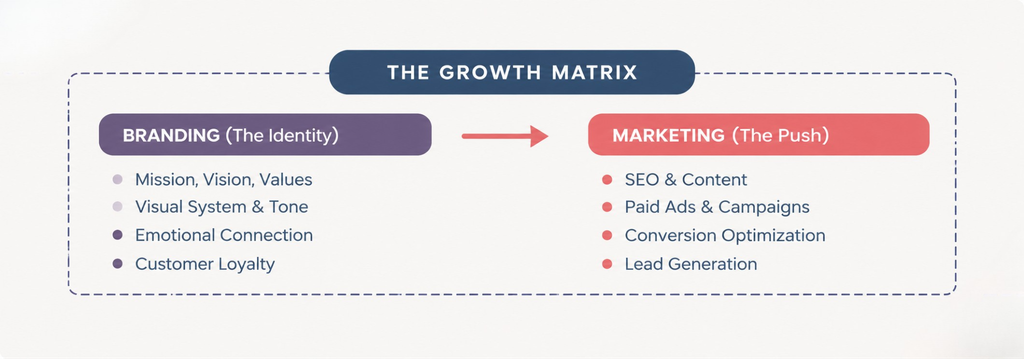
Branding is the practice of shaping how the market perceives your organization. It encompasses your core mission, core values, visual identity (logos, typography, color palettes), tone of voice, and the emotional promise you deliver at every touchpoint.
- Focus: Long-term brand value and reputation.
- Goal: Cultivate trust, recognition, and customer loyalty.
- Impact: Determines whether a customer chooses you over a competitor when prices and features are identical.
Marketing: The Tactical Engine
Marketing is the strategic execution used to promote your brand, reach target audiences, and generate measurable revenue. It encompasses digital advertising, Search Engine Optimization (SEO), content strategy, social media management, email marketing, and conversion funnel optimization.
- Focus: Short-to-medium-term campaigns and performance metrics.
- Goal: Drive awareness, traffic, leads, and sales conversions.
- Impact: Determines how effectively you reach qualified prospects and convert them into buyers.
The Golden Rule: Marketing invites customers to your story; branding is what convinces them to stay. Running paid ads or digital marketing without a solid brand identity is like pouring water into a leaking vessel.
2. The Multi-Channel Marketing Ecosystem
A brand identity must be deployed through an integrated digital marketing engine. Modern consumers interact across multiple touchpoints before making a purchasing decision, making a multi-channel digital strategy essential.
Search Engine Optimization (SEO) & Intent Capture
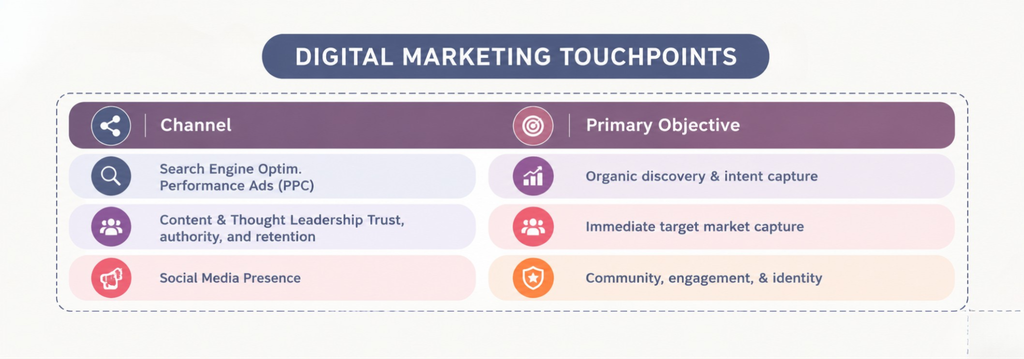
Search engines remain the primary destination for intent-driven consumers. A brand built for authority must dominate relevant search engine results pages (SERPs). Modern SEO extends beyond keyword placement; it requires technical website architecture, intuitive user experience (UX), schema-structured markup, and high-value, comprehensive content.
Paid Media & High-ROI Campaigns
While organic SEO builds compounding value over time, performance advertising (PPC across Google, Meta, LinkedIn, and programmatic channels) delivers immediate market reach. By pairing highly targeted creative ad assets with intent-based landing pages, businesses can accelerate acquisition while testing brand messaging in real time.
Content Marketing & Strategic Narrative
Content bridges the gap between passive awareness and active engagement. Thought leadership articles, white papers, case studies, and video content give your audience clear proof of your capability. High-value content answers customer pain points, establishes industry authority, and provides the narrative backing for your performance marketing campaigns.
3. Technology as the Enabler: Custom Web & Digital Development
Marketing and branding strategies cannot succeed without modern, resilient technical infrastructure. Your website or digital application serves as the central hub for your brand. If a prospective client clicks an optimized ad or high-ranking organic link only to land on a slow, poorly designed platform, your brand equity dissipates instantly.
| Strategic Priority | Technical Requirement | Brand Impact |
| Site Speed & Performance | Sub-second load times, clean code, cloud optimization | Signals professionalism, reliability, and modern authority. |
| Responsive UI/UX | Mobile-first design, fluid layouts, intuitive navigation | Reduces friction, lowers bounce rates, and boosts user confidence. |
| Conversion Optimization | Strategic calls-to-action (CTAs), streamlined checkout/forms | Converts visitors into loyal customers efficiently. |
| Data & CRM Integration | Automated lead tracking, business process automation | Enables personalized follow-ups and scalable operational growth. |
4. How Uvani Groups Accelerates Business Transformation
Navigating the complexities of modern digital marketing, brand positioning, software engineering, and automation requires an integrated technology and marketing partner.
As a full-suite digital solutions and technology partner, we help organizations scale by unifying branding, digital marketing, and software engineering into a cohesive growth strategy.
Core Capabilities Offered by Uvani Groups:
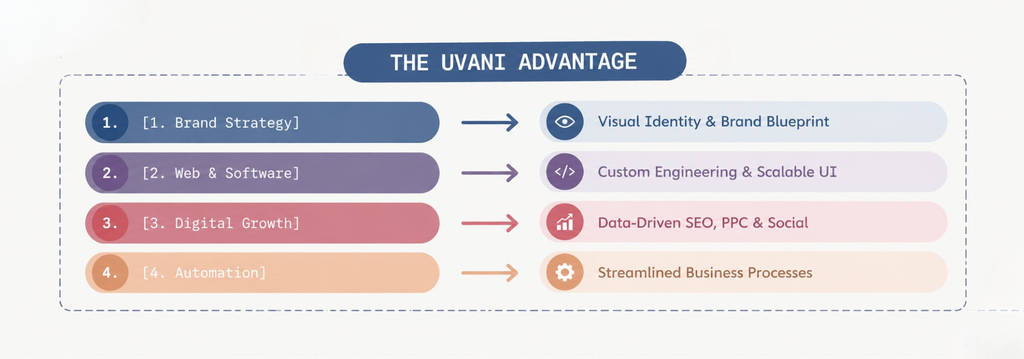
- Brand Strategy & Visual Design: Engineering distinctive brand identities, logo systems, guidelines, and positioning frameworks that stand out in crowded markets.
- Web & Application Development: Building high-performing, custom web portals, corporate sites, and scalable applications optimized for conversion and user experience.
- Data-Driven Digital Marketing: Developing targeted organic search (SEO), performance advertising, social media campaigns, and creative content strategies that maximize ROI.
- Business & Sales Automation: Streamlining client workflows, lead management pipelines, and internal business processes to prepare businesses for long-term scale.
By aligning engineering quality with marketing execution, we helps businesses establish market authority, streamline operations, and capture sustainable market share.
5. A Framework for Building an Integrated Growth Strategy
To combine marketing and branding into a clear roadmap, organizations should follow this four-phase growth framework:
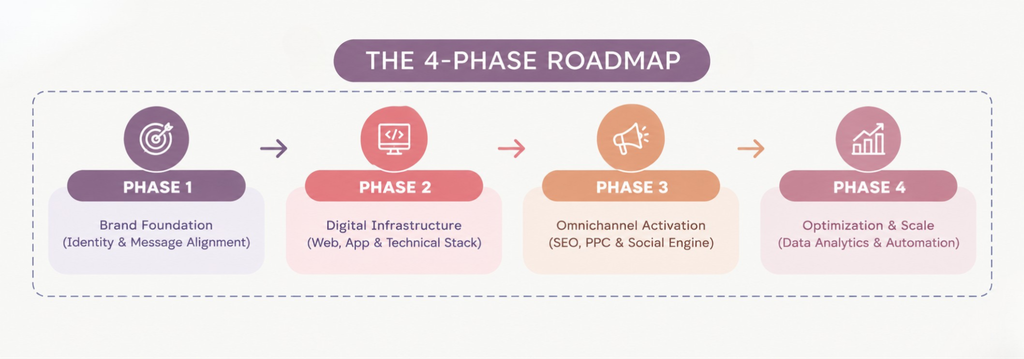
Phase 1: Establish the Brand Foundation
Before spending resources on active promotion, clarify your core positioning. Conduct thorough audience research, map competitor gaps, define your unique value proposition (UVP), and construct a cohesive visual and verbal style guide.
Phase 2: Build Scalable Digital Infrastructure
Develop a modern digital touchpoint, whether a custom website, enterprise platform, or e-commerce web app. Ensure the platform is responsive, fast, secure, and fully aligned with your visual branding.
Phase 3: Launch Targeted Acquisition Campaigns
Deploy integrated marketing campaigns across the digital channels where your target audience spends their time. Combine long-term organic strategies (SEO, inbound content) with direct performance marketing (paid search, targeted social ads) to capture both long-term authority and immediate demand.
Phase 4: Measure, Automate, and Optimize
Track key performance indicators (KPIs) beyond vanity metrics. Measure Customer Acquisition Cost (CAC), Lifetime Value (LTV), Return on Ad Spend (ROAS), and conversion rates. Use these insights to refine your marketing messaging, optimize landing pages, and automate recurring processes.
Frequently Asked Questions (FAQ)
1. Should a company focus on branding or marketing first?
Branding should always precede aggressive marketing campaigns. Establishing your brand identity, core messaging, and digital infrastructure ensures that every dollar spent on performance marketing and ad campaigns successfully drives trust, conversion, and long-term customer retention.
2. How do bad website UX and technical performance damage brand perception?
Your website acts as your primary digital storefront. High bounce rates, slow load times, broken layouts, or confusing user flows instantly erode customer trust, signal a lack of professionalism, and drastically decrease the conversion rates of your paid ad campaigns.
3. What is the difference between brand equity and digital marketing ROI?
Digital marketing ROI measures short-term revenue outcomes generated directly from specific campaigns (e.g., clicks, leads, immediate sales). Brand equity represents the long-term, cumulative commercial value derived from consumer perception, brand recognition, and market reputation over time.
4. How does SEO contribute to long-term brand authority?
Appearing consistently at the top of organic search results builds inherent trust and category leadership in the minds of consumers. High organic search visibility signals to potential customers that your business is an established authority within your industry sector.
5. How can an integrated partner like Uvani Groups streamline business growth?
Rather than managing separate agencies for software engineering, website development, brand design, and ad management, an integrated partner like Uvani Groups provides end-to-end alignment. By uniting technical architecture with strategic marketing, your growth engine operates seamlessly, reducing overhead and maximizing overall ROI.
The Future of Growth is Unified
The debate between prioritizing branding or marketing is over. Sustainable growth requires both. Branding creates the trust, authority, and recognition that makes customers care; marketing provides the visibility, reach, and conversion engines that turn interest into revenue.
As technologies evolve and digital channels become more competitive, businesses that integrate identity, high-performing web engineering, and performance marketing will lead their industries.
Whether you are launching a new enterprise or modernizing an established brand, partnering with an experienced technology and growth agency like Uvani Groups provides the strategic direction, design excellence, and technical foundation needed to turn digital potential into market dominance.