
The enterprise technology landscape has reached a pivotal juncture. For the past decade, digital transformation focused primarily on digitization and automation: replacing manual spreadsheets with cloud databases, converting paper workflows into digital portals, and using rule-based chatbots to manage high-volume customer inquiries.
Today, we are witnessing the transition from passive software to autonomous digital systems.
At the center of this shift are two converging paradigms: Agentic Commerce and AIOps (Artificial Intelligence for IT Operations).
While Agentic Commerce redefines how products, services, and digital transactions are discovered, negotiated, and executed by autonomous AI agents, AIOps provides the self-healing, intelligent infrastructure required to support these machine-to-machine interactions at scale.
For forward-thinking enterprises, business leaders, and technology executives, understanding how these two domains intersect is no longer optional; it is the foundational architecture for modern digital dominance.
Part 1: Deconstructing Agentic Commerce
From Search Bars to Autonomous Transaction Engines
Traditional e-commerce relied entirely on human browsing loops. A customer identified a need, navigated to a search engine or specific platform, applied filters, compared pricing, evaluated reviews, and manually entered payment details through a checkout funnel.
Agentic Commerce eliminates this friction by deploying goal-oriented, decision-making AI agents that execute multi-step commercial workflows on behalf of human users or corporate entities.
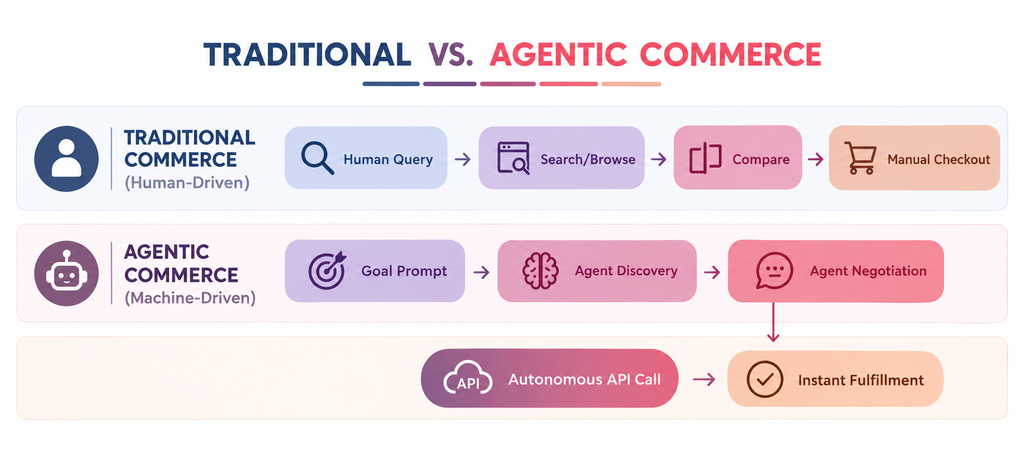
An AI commerce agent does not simply retrieve links or display products; it evaluates intent, analyzes real-time inventory, negotiates dynamic pricing models via API endpoints, verifies compliance requirements, and completes cross-border financial transactions using secure, verifiable protocols.
Key Drivers Accelerating Agentic Commerce
- Large Action Models (LAMs) & Tool Use: Advanced AI models no longer just generate text; they read structured APIs, interface with legacy software, and execute complex tool chains without human intervention.
- Contextual & Predictive Procurement: In B2B supply chains, autonomous agents monitor real-time consumption rates, predict material shortages, and initiate supplier purchase orders before inventory bottlenecks occur.
- Hyper-Personalized Consumer Agents: Personal AI assistants act as trusted gatekeepers, filtering out commercial noise and selecting goods strictly aligned with verified user preferences, budget constraints, and sustainability criteria.
Part 2: The Infrastructure Foundation – Understanding AIOps
While Agentic Commerce transforms the front-end dynamic of digital trade, it places unprecedented stress on underlying enterprise systems. Autonomous AI agents generate erratic traffic spikes, complex multi-API dependency chains, and real-time execution demands that traditional, human-managed IT operations cannot sustain.
This is where AIOps (AI for IT Operations) becomes mission-critical.
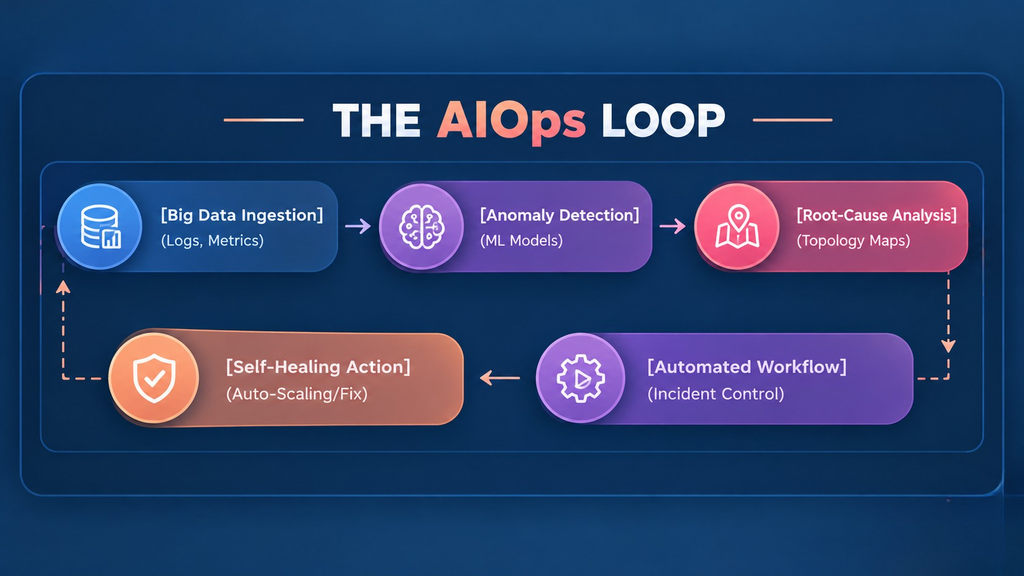
AIOps combines machine learning, big data analytics, and continuous observability to automate operational workflows across enterprise IT environments. Rather than relying on IT teams to manually analyze log files and respond to system alerts, AIOps architectures perform continuous, proactive monitoring:
- Event Correlation & Noise Reduction: Filtering out thousands of redundant alerts to pinpoint the exact root cause of infrastructural stress.
- Predictive Anomaly Detection: Identifying performance degradation, memory leaks, or cloud infrastructure bottlenecks before they trigger system downtime.
- Automated Remediation (Self-Healing): Dynamically spinning up cloud microservices, rerouting network traffic, or executing code patches without human intervention.
Part 3: The Convergence – Why Agentic Commerce Demands AIOps
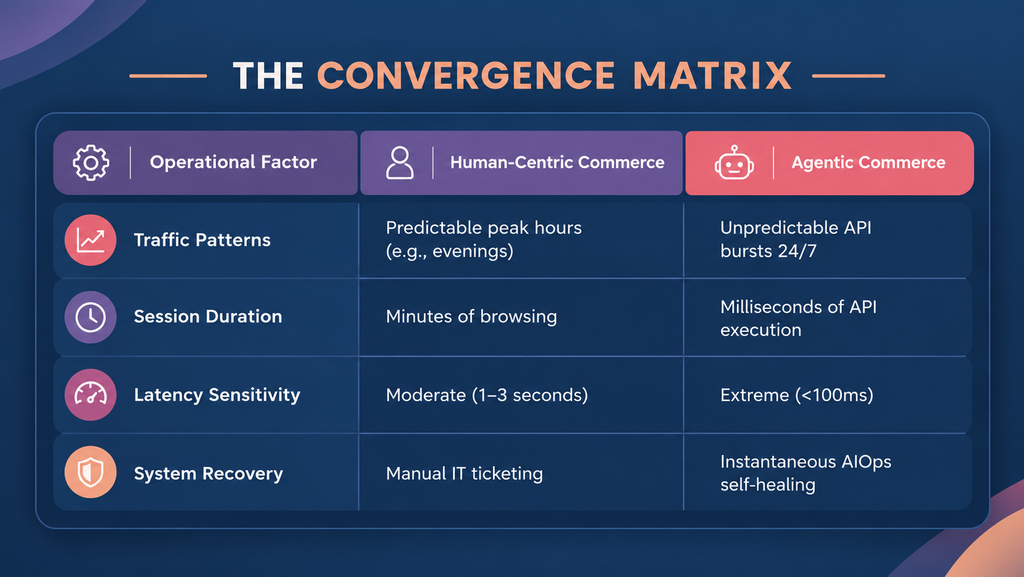
Agentic Commerce cannot function reliably on legacy IT infrastructure. When software agents replace human shoppers, the operational dynamics of digital business change fundamentally across four key dimensions:
1. Millisecond-Level Latency Requirements
A human customer might tolerate a 2-second delay while a checkout page loads. An autonomous shopping agent, executing hundreds of parallel API evaluations across multiple vendors, will instantly abandon an endpoint if response latency breaches strict thresholds. AIOps ensures continuous micro-performance optimization across cloud services to keep response times under 100 milliseconds.
2. Eliminating Single Points of Failure
If an API gateway or payment verification service fails during an agent-driven B2B negotiation, the entire transaction chain breaks. AIOps platforms detect real-time API performance drops, immediately executing failovers to redundant microservices or secondary cloud regions before the agent session terminates.
3. Dynamic Elastic Scaling for API Bursts
Agentic traffic does not follow human routines like morning coffee browsing or holiday sales events. A fleet of procurement agents may execute millions of programmatic queries within a 10-second window. AIOps leverages predictive telemetry to pre-scale cloud server allocations, preventing system outages caused by sudden API floods.
Part 4: Key Pillars of an Autonomous Enterprise Architecture
To succeed in this evolving paradigm, technology leaders must design an enterprise architecture built on four core pillars:
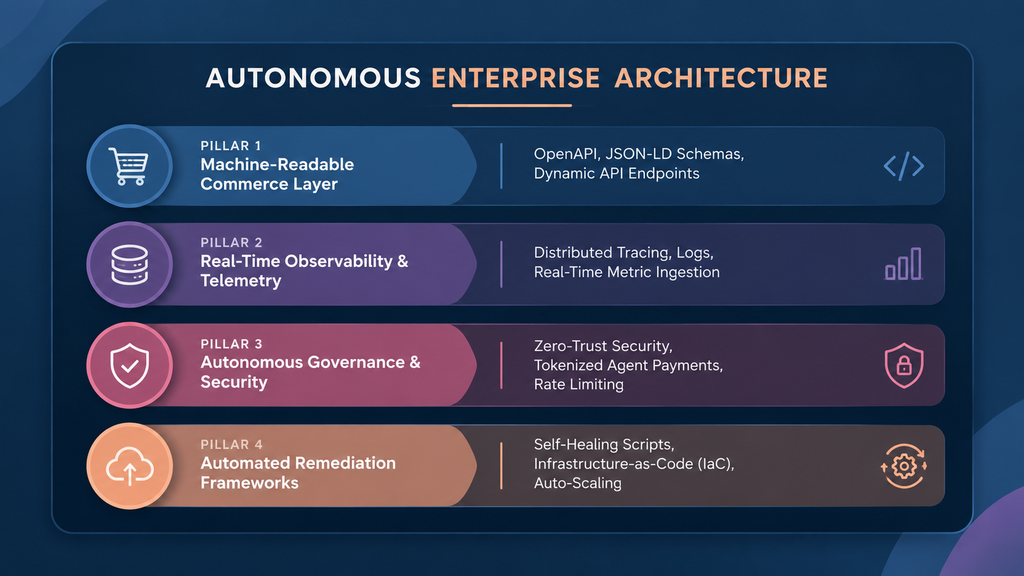
Pillar 1: Machine-Readable Commerce Interfaces
Websites must evolve beyond human-facing graphical interfaces (GUI). Enterprises need machine-readable endpoints equipped with robust structured data (JSON-LD), standardized API documentation, and agent-negotiation protocols that allow external AI systems to query pricing, availability, and specs frictionlessly.
Pillar 2: Full-Stack Observability
AIOps requires high-fidelity telemetry to make intelligent operational decisions. Organizations must unify metric collection across custom applications, cloud hosting infrastructure, API gateways, and enterprise databases into a central telemetry pipeline.
Pillar 3: Zero-Trust Agent Security & Identity Management
Granting commercial autonomy to AI agents presents novel security challenges. Systems must implement zero-trust verification frameworks, cryptographic agent signatures, strict rate-limiting, and micro-transaction spend caps to prevent exploitation or automated fraud.
Pillar 4: Automated Incident Remediation
System recovery must move from manual ticketing systems to automated execution loops. When anomaly detection algorithms spot infrastructure stress, Infrastructure-as-Code (IaC) pipelines should automatically reconfigure routing, adjust database connections, or deploy server resources.
Frequently Asked Questions (FAQ)
What is the core difference between traditional AI in e-commerce and Agentic Commerce?
Traditional AI in e-commerce focuses primarily on passive recommendations (e.g., “Customers who bought this also liked…”) and basic customer service chatbots. Agentic Commerce involves goal-driven AI agents capable of reasoning, selecting products, negotiating terms, calling external APIs, and completing financial transactions autonomously without requiring human intervention.
How does AIOps differ from standard IT monitoring?
Standard IT monitoring tools collect performance data and notify human engineers when predefined thresholds are breached (e.g., CPU utilization hitting 90%). AIOps uses machine learning to correlate complex events across distributed systems, detect subtle anomalies proactively, identify root causes, and execute automated self-healing workflows without waiting for human input.
Why is API performance so critical for Agentic Commerce?
In Agentic Commerce, AI agents communicate primarily through application programming interfaces (APIs) rather than human web interfaces. If an API experiences high latency, incorrect data formatting, or downtime, the autonomous agent will discard that vendor in favor of an endpoint that delivers reliable, instant execution.
What security risks are associated with autonomous AI shopping agents?
Key risks include programmatic API abuse, credential theft, rogue agent spending, and prompt injection attacks targeting vendor APIs. Mitigating these risks requires zero-trust access policies, cryptographic agent identities, automated rate-limiting, and real-time transaction monitoring powered by AIOps.
How do Agentic Commerce and AIOps work together in enterprise technology?
Agentic Commerce acts as the front-end driver of autonomous digital transactions, generating complex, rapid API workloads. AIOps serves as the back-end engine, ensuring the underlying server infrastructure, cloud networks, and databases remain performant, resilient, and self-healing to process those workloads seamlessly.
Conclusion: Preparing Your Enterprise for the Autonomous Future
The convergence of Agentic Commerce and AIOps represents a fundamental shift in digital business. As commercial transactions transition from human-driven web browsing to machine-driven API execution, competitive advantage will belong to organizations that combine seamless, agent-ready commerce channels with resilient, self-healing IT infrastructure.
Navigating this transition requires strategic vision, robust digital architecture, and an ongoing commitment to technological excellence. By staying informed on emerging research, modern software standards, and enterprise AI frameworks, business leaders can position their organizations at the forefront of the autonomous economy.
This strategic industry insight is provided for informational purposes by Uvani Groups, a technology and digital solutions provider dedicated to sharing knowledge on enterprise software, modern web architecture, and emerging technology trends.